Gaffer Tape, Gear Oil and a Kettle: Three Club Racers Who Live Out of Their Vans
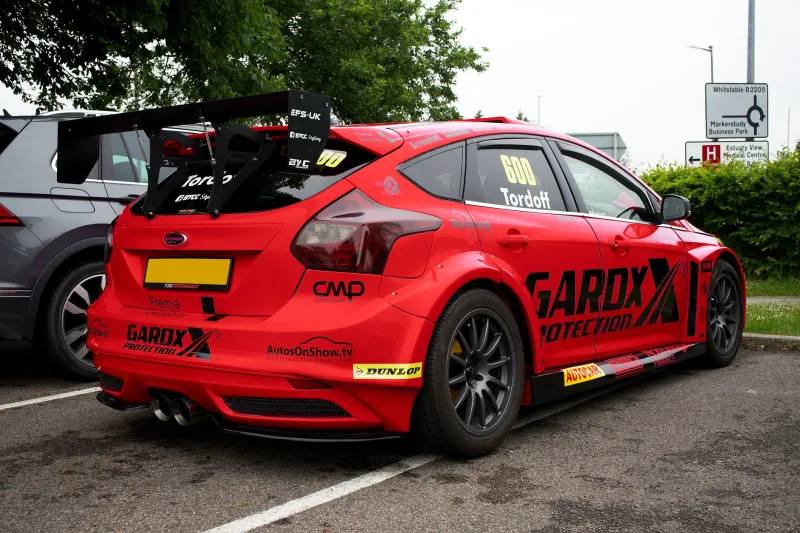
At a damp November club oval, the race car gets the attention. People lean over the cage, poke at the carb and nod wisely at the rear tyres. The van, parked slightly crooked with one rear door open, gets ignored. Which is a bit unfair, because without it half the grid would still be at home with a spanner in one hand and a cup of tea going cold in the other.
Grassroots oval racing runs on vans. Not shiny race transporters with vinyl graphics and a coffee machine in the side pod, but high-mileage Transits, borrowed trailers, old Sprinters and family Vivaros with a tow bar bolted on and a set of axle stands rattling around in the back. The car is the headline. The van is the infrastructure.
The Rolling Workshop
Hannah, 29, races a 1300 Stock Car at a Midlands club. Her van is a 2008 Ford Transit Mk7 that has done more trips to scrapyards than she cares to count. During the week it carries tip runs, flat-pack furniture and the occasional bag of cement. On race weekends it becomes a mobile parts department.
Inside, there are shelving units held together with cable ties, Really Useful Boxes labelled in marker pen and a permanent smell of gear oil and old coffee. One side has brake cleaner, cable ties and a full set of spanners. The other has a spare radiator, two used tyres and a folding chair that has seen better days.
'The van is the reason we make the grid,' Hannah says. 'If we had to load everything into a car and trailer every time, we would miss half the meetings. Having the spares in the van means we can fix things in the paddock instead of driving home for a part.'
Over winter 2026/27, the Transit is getting the same treatment as the race car: a proper service, a look at the brakes, a patch of welding on the rear arch and a new set of tyres that are actually legal. 'You can have the best short-track car in the club,' she says, 'but if the van fails its MOT in March, you are watching from the fence.'
The Brew Station and the Borrowed Trailer
Owen, 41, races a club-level Hot Rod in West Yorkshire. He tows with a borrowed trailer behind a Mercedes Sprinter that has done north of 180,000 miles. The van is not pretty. It has a dent in the rear door, a crack in the bumper and a kettle that lives permanently on a small gas stove near the side door.
'People laugh at the brew station,' Owen says. 'Then it rains, the meeting gets delayed, and suddenly everyone is standing under the awning with a mug. It is the most popular van in the paddock.'
The side door opens out into a makeshift shelter with a tarpaulin, four bungee cords and a bit of hope. Inside, there is a toolbox, a jump pack, a bag of rags, a spare set of wheels and a stash of biscuits for the crew. The trailer is borrowed from a mate. The van is old enough to have a personality. Owen admits the combination is held together by routine and gaffer tape.
'You learn to check the trailer lights before you set off, not after,' he says. 'You learn to put the heavy stuff over the axle. You learn that a borrowed trailer is fine as long as you return it cleaner than you borrowed it and with the tyres pumped up.'
The Sprinter also does the family transport when needed. It takes Owen's kids to school, carries bikes and occasionally doubles as a removal van for friends. 'It is not a race van,' he says. 'It is a van that goes racing.'
The Parts Store That Does the School Run
Priya, 36, races a grassroots Banger in Kent with her brother. Their van is a Vauxhall Vivaro. On Friday night the rear seats come out and the spares go in: a used wing, a box of nuts and bolts, a trolley jack, two axle stands, a battery and a bag of zip ties. On Monday morning the seats go back in and the van becomes a school run machine again.
'The kids know the difference between a wheel brace and a torque wrench,' Priya says. 'They also know that if they leave a crisp packet in the back, it will end up in the pit bag. It is a family van. It just happens to have a race car attached to it every other weekend.'
The Vivaro is not perfect. There is a scrape down one side from a tight gateway at a club oval and a small leak in the roof that appears only in heavy rain. But it carries the whole team: Priya, her brother, a folding gazebo, a cool box, a flask and enough tools to rebuild most of the car in a lay-by.
'We looked at a proper van once,' she says. 'Then we worked out how much racing we could do for the same money. The Vivaro stayed.'
The Unflashy Sixth Crew Member
At professional level, logistics are handled by someone else. At club level, the van is the logistics. It gets the car to the grid, the spares to the paddock and the crew home when the meeting runs late. It is the reason a wet Saturday does not turn into a disaster and the reason a snapped bolt on Sunday morning does not end a season.
It is also the reason club racing remains a family affair. The van takes the race car, the kids, the dog and the flask. It sits in the queue at scrutineering with the heater on. It provides shelter when the wind picks up. It carries the trophy home in a plastic bag because nobody remembered to bring a box.
So next time you are at a club oval, have a look at the vans. The one with the dented door and the kettle on the tailgate. The one with the borrowed trailer and the driver checking the lights for the third time. The one with the school seats folded down and the race spares stacked behind them. That is not background clutter. That is the team.
OvalTrack UK will be back at the fence in 2027, and the vans will be there too, loaded to the roof and ready for another season.