Four Quid a Corner: How Part-Worn Rubber Keeps Club Oval Racing on the Grid
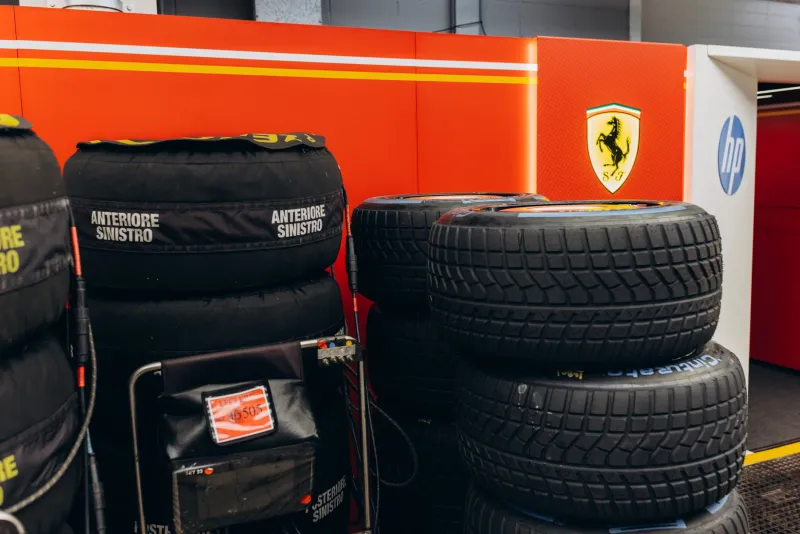
The first thing you notice in Darren Uttley's lock-up behind a garden centre on the edge of Wisbech isn't the car. It's the tyres. Four high against the breeze block, chalked with codes, one or two still grey with the dust of a Sunday afternoon at Mildenhall.
"People hear 'part-worn' and think scrap," he says, rolling one into the light from a bare bulb. "But someone's already paid the first three-quarters of the bill. I'm only paying the last bit."
That's the whole trade in a sentence. Walk down any club oval paddock in Britain on a race night and you'll see the evidence: tyre stacks with names scrawled on the sidewalls, wheelie bins full of rubber, a bloke in a Transit doing quiet business behind the burger van. Very few people at this level are buying new. Almost everybody is buying somebody else's old.
Why the fresh stuff rarely adds up
A set of new competition tyres can set you back somewhere between £400 and £600 before you've paid your entry fee, your fuel, or the welder who sorted your cage. A tidy little club car might be worth £1,200 in total. Spending half that on four tyres that will be square again by July is a maths problem most people quietly refuse to do.
Then there's the part nobody mentions at the start: driving home on tyres that only half work. A beginner on fresh rubber can develop habits that fall apart the moment the budget tightens. Learning on a harder, older, more talkative tyre teaches you to feel the front go light before it actually does. There's a reason so many seasoned campaigners reckon a scrub set is the better teacher.
The legal line, without the lecture
This is where it gets serious, so bear with it. In the UK, any tyre sold as part-worn for road use has to be marked PART-WORN in letters at least 4mm high, must be free of bulges, cuts and exposed cords, and must have at least 1.6mm of tread across the central three-quarters of its width right the way round. Those rules exist because someone, once, tried it on.
Competition tyres and race-only rubber sit in a slightly different world — but don't assume that means anything goes. Club scrutineers have their own views, some formulas ban certain compounds outright, and a sidewall with a cut in it is a bad idea whether or not a rulebook mentions it.
Before any money changes hands, learn to read a date code: four digits, week and year, moulded into the sidewall. A tyre that's spent eight summers baking on a trailer in Kent isn't a bargain, whatever the tread looks like.
Where the deals actually happen
The Facebook groups do most of the heavy lifting. Search your formula, add 'spares' or 'for sale', and you'll find everything from a single tyre offered free to whoever collects it, to a set of four with photos of every sidewall taken in good light. WhatsApp groups run by the promotion or the club are quicker still — half the transfers at a meeting are agreed before anyone's signed on.
Then there's the paddock itself. Every club has a tyre person: the one with a trailer full of matched pairs, a pressure gauge in their pocket and an opinion on everything. Be decent to them. They will remember that you returned the wheel you borrowed in March.
Every formula has its own tyre culture
This is the bit newcomers get wrong, because the rules vary wildly from class to class.
Bangers are the free-for-all. Any road tyre that holds air is broadly fair game at many promotions, which is why you'll see a Ford Focus running odd sizes and mismatched brands without a second glance. Some meetings specify road tyres only, no remoulds, no winter tyres — check the rules before you load up.
Hot rods, stock cars and the junior formulas usually run a control tyre. That kills the bargain-bin side of things and replaces it with something subtler: the market in scrubbed control tyres, part-worn but correct, sold between drivers who've moved to a different compound.
Autograss splits by class, and some classes are far fussier than others about what you're allowed to bolt on.
Speedway is its own country. The rear tyre is controlled, marked and checked, and riders are limited on how many they can use at a meeting. The used market there is mostly practice rubber and grasstrack leftovers — useful, but not the same trade you'll find on the short ovals.
Where the bargain has to stop
Walk away from: bulges anywhere, cuts deep enough to show cord, anything that's been repaired in the sidewall, beads that look chewed, tyres that have clearly been run flat, and anything you can't identify. A pair matched in size and age is worth more than a set of four strangers.
And ask what they came off. A tyre that spent a season on the back of a front-wheel-drive banger has lived a very different life to one that's done two laps and gone in a shed.
The storage etiquette nobody teaches you
Keep them out of sunlight, off bare concrete, away from the boiler, and wrapped in bin bags if they're going to sit for months. Chalk the size, the date code and the name of whoever you bought them from on the sidewall. When you lend a set, write that down too. The grassroots tyre economy runs entirely on people remembering who owes what.
The honest sums
A set of four usable part-worns at £40, rotated sensibly across a season and topped up with a couple of scrounged singles, can carry a club racer through ten or twelve meetings. That's roughly the price of one tank of diesel in the van. It is not glamorous, it will never be Instagram-worthy, and every single person who's ever won a heat on a scruffy set of second-hand rubber knows exactly why they did it.
Darren puts the tyre back on the stack and wipes his hands. "New tyres buy you a tenth," he says. "Being out there every week buys you a season."