The Corner Where the Race Actually Happens
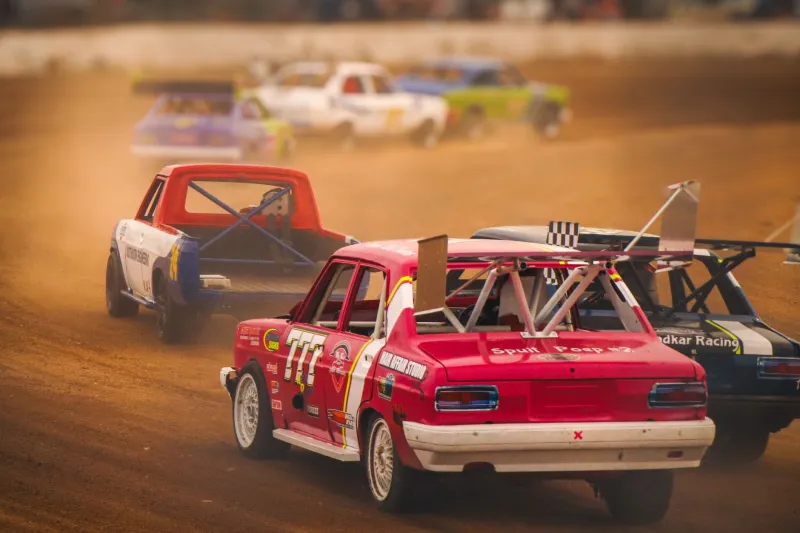
Thirty miles an hour does not sound like a motorsport headline. It sounds like a traffic report. But stand on the fence at a grassroots oval on a damp Saturday night and you will see the race happen at exactly that speed: two cars nose-to-tail through a rutted corner, one driver hanging it round the outside, the other chopping down to the white line, both of them refusing to be the first to lift.
The fastest part of the track gets the noise. The slow corner gets the story.
The straight is just admin
A straight is where engines do their work and spectators check their phones. It matters, obviously. Nobody wins a final without a decent motor. But the straight is mostly a rehearsal for the next corner. The actual decisions, the ones that make you wince and then laugh, happen when the cars are slow enough for the driver to have a think.
At 30mph, a grassroots racer has time to choose a line, change their mind, and then regret it. At 70mph on the straight, they are a passenger with a steering wheel. The slow corner is where the race becomes human.
I have watched mid-pack heats where the lead battle was a procession and the real entertainment was three cars fighting over sixth. One was trying to make the outside work, one was defending a line that had stopped working two laps earlier, and one was simply waiting for both of them to run out of road. It was messy, scrappy and far more absorbing than the clean getaway at the front.
Line choice when the grip disappears
Talk to drivers about the slow corner and you rarely get a simple answer. The fast line is not always the quick line. The quick line is not always the line you can hold for fifteen laps. Track conditions shift through the evening, and a corner that was black and grippy during practice can become a shiny, greasy puzzle by the second heat.
A driver from the Midlands who races stock cars on a mix of shale and tarmac puts it simply: the slow corner is where you find out who has been paying attention. Everyone can be brave on a wide, dry track. Not everyone can be patient when the grip goes away.
Track preparers know this better than anyone. They are not just watering or grading for the sake of it. They are shaping a conversation between the surface and the drivers. A little more moisture here, a little less there, and the corner changes character. The outside might come alive. The inside might go off. A line that worked in the first heat might be a trap by the final.
That is why you see drivers walking the track before racing, peering at the surface like they have lost a contact lens. They are not being precious. They are reading the corner.
Track prep is a conversation
From the fence, it is easy to miss the quiet work that goes into a slow corner. A tractor goes round, the surface changes colour, and everyone gets on with it. But the best track preparers are not trying to make a perfect racetrack. They are trying to make a racetrack that gives drivers options.
Too much grip and the fast line becomes obvious. Too little and the corner becomes a lottery. The sweet spot is when a driver has to think: do I go round the outside and hope the moisture holds, or do I tuck it down the inside and accept that I might get pinched? That is when the slow corner becomes a proper duel.
One regular fan at a short-track venue in the south-east told me he deliberately watches the slowest corner on the lap. He likes the noise, the smell of hot rubber and the way a driver's shoulders move in the cockpit as they wrestle the wheel. The main straight gives him speed. The slow corner gives him a story to tell on the drive home.
Mid-pack heats deserve the main-event noise
Grassroots oval racing has a habit of treating the final as the only race that matters. That is understandable. Finals have trophies, photographs and a bit of ceremony. But the mid-pack heats are where the sport's character lives. They are where rookies learn, where old hands test a new line, and where the difference between a good driver and a lucky one gets exposed.
A heat that decides sixth place might not make the track's social media post. It might not get a mention on the PA beyond a mumbled lap chart. But watch the drivers after they climb out. They know exactly what happened. They will replay the corner in their heads, then in the pits, then in the bar. The slow corner has a long afterlife.
What to watch from the fence
If you are new to short-track racing, pick a corner rather than the start line. You will see more of the race. Look for the driver who brakes a little later than everyone else but still gets the car rotated. Watch the defender who deliberately leaves a sliver of inside space and then closes it just enough. Notice the car that looks slow on the straight but makes up ground every time the track goes tight.
The fastest straight will always get the noise. The slow corner gets the racing. At a grassroots oval, that is where you will find the sport at its most honest: a bit scruffy, a bit stubborn, and all the better for it.