Numbers, Names and Nerve: The Winter Craft of Lettering a Club Oval Car

Photo: signwriter applying vinyl lettering to race car in workshop, via fontmeme.com
The kettle is doing most of the talking when I arrive at a unit on the edge of the Fens. Outside, a van is parked nose-in with its back doors open, and inside it looks less like a delivery vehicle and more like a stationery cupboard that has been through a tumble dryer: rolls of vinyl, backing paper, squeegees, a tin of enamel, and a bundle of number packs held together with masking tape.
It is mid-November, and the 2026/27 rebuild rush is in full swing. For club oval racers, winter is not a quiet season. It is a queue. Engines get pulled, panels get beaten, and somewhere near the end of that queue sits a signwriter with a scalpel in one hand and a hairdryer in the other, trying to turn a bare aluminium door into something that looks like a race car again.
Mick Draper has been lettering club cars since the late 1980s. He started with a brush and a pot of enamel, moved into vinyl when the club paddock did, and now runs a one-man lettering business that seems to survive on equal parts craft, coffee and deadline pressure. 'People think it is the last job,' he says, peeling a backing sheet away from a roof number. 'It is actually the job that tells everyone the car is finished.'
The winter rush starts with a blank door
In the workshop, a hot rod sits on stands with one side still in grey primer. The owner wants a full set of numbers, a name on the door, three sponsor logos and a small memorial motif near the rear quarter. The car is due at scrutineering in nine days. Draper has already told him it will be tight, which in signwriting terms means it will happen, but the kettle will earn its keep.
The first job is not the flashy bit. It is measuring. Draper checks the door panel, the roof, the rear quarter and the front valance, then writes a set of dimensions on the back of an old race entry form. Club cars are rarely flat or symmetrical. A panel that looks square at arm's length can be two centimetres out once you lay a tape across it. Vinyl is unforgiving about that kind of thing.
'You cannot just cut a number and slap it on,' he says. 'You have to read the car. Where is the light going to hit it? Where is the crease? Where has someone had a go with a hammer and a block of wood?'
That reading of the car is part of the trade. A good signwriter can make a slightly tired shell look sharp without pretending it is new. The aim is not showroom gloss. It is legibility, identity and a bit of pride in the paddock.
Vinyl speed and enamel patience
Halfway down the bench, Ellie Shaw is cutting a sponsor decal on a plotter that sounds like a small printer having a difficult morning. Shaw came into lettering through the vinyl boom, but she has started learning brush work too. 'Vinyl pays the bills,' she says. 'Enamel teaches you why the old boys are so fussy.'
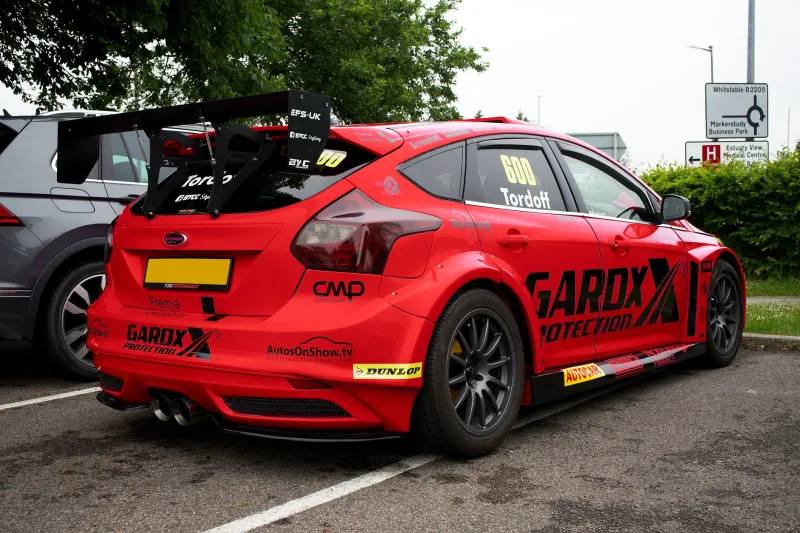
Vinyl is quick, clean and comparatively cheap. It can be replaced after a hard night, matched to a sponsor's brand colours and cut in a number of fonts that would have taken hours to lay out by hand. On a club car that might get a new door skin halfway through the season, that practicality matters.
Enamel is slower. It needs a steady hand, a decent brush and patience with drying times. It also has a depth that vinyl cannot quite copy, especially on traditional lettering styles. Some owners still ask for hand-painted numbers because their father's car had them, or because they want the car to look like it belongs to a particular era rather than a particular spreadsheet.
'There is room for both,' Draper says. 'A lot of cars end up with vinyl for the numbers and enamel for the little touches. Nobody is handing out medals for purity. The car has to look right and get to the track.'
The square foot that carries a season
On a club oval car, the number panel is not just decoration. It is how the lap scorer finds you, how the commentator calls you and how a spectator picks you out when three cars come out of the same corner in a cloud of shale and noise. In a paddock full of second-hand steel, a clean number is a public service.
Sponsor decals are a different kind of language. A local garage, a tyre firm, a builder's merchant, a family business that has put in fifty quid and a box of tea bags: these names matter. They are the visible thread between a club racer and the town around the track. A signwriter who can make those logos sit neatly on a cramped door panel is doing more for the sport than the average spectator realises.
Then there is the lettering nobody photographs. Names of lost mates. Dates. A small motif that means something to one family and nothing to anyone else. Shaw says those jobs are handled with a different kind of care. 'You do not rush them,' she says. 'You check the spelling twice. You let the owner stand next to you and decide where it goes. It is not a decal. It is somebody's memory.'
Why presentation still matters in a paddock of beat-up steel
There is a temptation to think that club oval racing is beyond presentation. The cars are built to be raced, not admired. Panels get bent, paint gets chipped, and the shale does not care how much time you spent lining up a door number. But that is exactly why a well-dressed car stands out. It says the crew has finished the job, not just got it running.
It also helps the meeting run. Clear numbers make life easier for officials and scorers. Neat sponsor panels keep the people who put money into the car feeling like part of the team. And for the driver, there is a small but real lift in walking out to a car that looks like it belongs on the grid rather than at the back of a scrapyard.
Draper is not sentimental about it. 'It is not about being pretty,' he says. 'It is about being clear. A race car should look like it knows what it is for.'
By the time I leave, the hot rod has a roof number, two door plates and a fresh sponsor panel on the rear quarter. The memorial motif is still on the bench, waiting for the owner to arrive. The van is still open, the kettle is still warm, and there is another car booked in for Monday. The 2026/27 season is still a few months away, but in this unit the grid is already taking shape, one number at a time.